
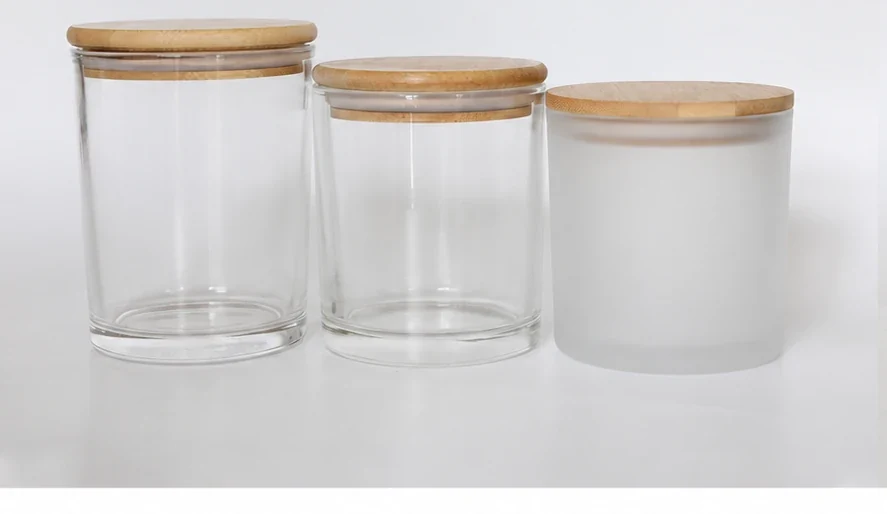
The vessel is one of the first things a customer notices about a candle. It also affects decoration, packing, and the tests needed before launch. Glass and ceramic can both support a premium line, but a material name alone cannot tell you which one fits your brief.
Start with the look you need to repeat
Clear or tinted glass lets the wax level and flame become part of the design. It works well when a brand wants visual consistency across scents and seasonal labels. Ceramic makes the vessel itself a stronger design element: color, glaze, and surface texture can carry the collection even when the candle is unlit. Neither is automatically more luxurious. Ask for physical samples in the actual color and finish, then compare them under your retail lighting.
Compare decoration on the finished vessel
For glass, discuss color coating, frosting, printing, and label adhesion on the specific shape you have chosen. For ceramic, discuss glaze variation, print placement, and how the finish looks around the rim and base. A design that looks perfect in a flat artwork file can behave differently on a curved surface. Approve a decorated sample, not only a digital mockup, and state which variations are acceptable in production.
Treat candle safety as a product-level decision
A candle vessel must be suitable for the intended candle. ASTM F2179-26 covers minimum performance requirements and associated test methods for annealed soda-lime-silicate glass containers produced for filled candles, including annealing and thermal shock requirements. Its scope is specific to that glass construction; it should not be used as a blanket certification for ceramic. ASTM F2417-26 addresses fire safety for the finished candle or candle ensemble. The candle maker should validate the actual wax, fragrance, wick, fill level, and vessel combination before sale.
When comparing samples, ask for the vessel material specification, dimensional tolerances, relevant test records, and the proposed inspection plan. Do not assume that a good-looking sample proves every future production batch will behave the same way.
Include the shipping configuration in the comparison
Both materials can break in transit. The question is how the finished, filled product will be protected in its real shipping route. Request a pack-out drawing showing inserts, dividers, retail box, and master carton. If units will ship individually by parcel, evaluate the complete packaged product for that distribution system. ISTA identifies Procedure 3A as a general simulation for individual packaged products shipped through parcel delivery systems up to 70 kg; the appropriate protocol still depends on the route and package.
A useful RFQ checklist
- Target capacity and the vessel’s inner and outer dimensions
- Wax, wick, fragrance, and intended fill level for burn validation
- Finish, decoration artwork, and acceptable appearance variation
- Lid fit, if a lid is part of the design
- Retail and master-pack configuration, plus the shipping route
- Sample approval criteria and test documentation required before production
If your brand needs a transparent, label-led presentation, start by sampling glass. If the vessel’s color and texture are central to the story, sample ceramic alongside it. Compare the decorated, filled, packed versions before committing to a material.
Planning a vessel brief? Send KEYIDI PACK your target dimensions, artwork, lid idea, and shipping market through the inquiry page. We can discuss a sample specification around the information you already have.